
NJ Anchor Guide
Executive Summary for the Taxpayer. New Jersey’s 2025 ANCHOR benefit is based primarily on whether you owned or rented your principal residence on October 1, 2025, your New Jersey gross income, and your age or disability status.NJ Division of Taxation ANCHOR guidance
The 2025 application cycle runs in 2026: automatic-filing recipients must correct information or change payment instructions by September 15, 2026, while applicants who must file independently generally have until November 2, 2026.NJ Property Tax Relief Programs
ANCHOR eligibility for homeowners and renters
ANCHOR provides a New Jersey property-tax-relief benefit to eligible residents who owned or rented their main home in New Jersey on October 1, 2025.NJ ANCHOR Program
For the 2025 benefit year:
- Homeowners generally qualify with 2025 New Jersey gross income of $250,000 or less.ANCHOR eligibility
- Renters generally qualify with 2025 New Jersey gross income of $150,000 or less.ANCHOR eligibility
- The property must have been your principal residence, meaning the home where you lived most of the time and where you generally received mail or were registered to vote.New Jersey property-tax-relief FAQ
- A vacation home, second home, or property you owned but rented to someone else does not qualify as your principal residence.ANCHOR eligibility
The 2025 ANCHOR benefit amounts are:
| Applicant | 2025 New Jersey gross income | Benefit |
|---|---|---|
| Homeowner | $150,000 or less | $1,500 |
| Homeowner | $150,001–$250,000 | $1,000 |
| Renter age 64 or younger | $150,000 or less | $450 |
| Renter age 65 or older | $150,000 or less | $700 |
A qualifying homeowner or renter age 65 or older who did not claim the available $50 New Jersey Property Tax Credit on the NJ-1040 may have that credit included with the ANCHOR payment.ANCHOR benefit calculation
2025 application and 2026 filing dates
The current cycle covers benefits based on 2025 residency, income, age, and disability information.NJ ANCHOR Program
Key dates are:
- August 10, 2026: The Division of Taxation sent ANCHOR Benefit Confirmation Letters to many residents whose applications are expected to be filed automatically.NJ ANCHOR Program
- September 15, 2026: Deadline to change direct-deposit information, request a paper check, or reject an incorrect property listed on an automatic-filing confirmation letter.NJ ANCHOR filing instructions
- November 2, 2026: Final deadline for the 2025 ANCHOR or PAS-1 application.NJ Property Tax Relief Programs
Most eligible homeowners under age 65 who are not receiving Social Security Disability or Railroad Retirement Disability benefits, along with most eligible renters, may be filed automatically based on prior-year information.NJ ANCHOR filing information
If the confirmation letter is correct, no additional application is generally required. If you did not receive a letter but believe you qualify, file through the New Jersey Property Tax Relief Portal before the November 2 deadline.NJ Property Tax Relief Programs
If the letter shows a property you did not occupy on October 1, 2025, select the option stating that you do not want an application filed on your behalf and complete that correction by September 15. If you qualified for a different New Jersey property that you occupied on October 1, you must file a new application for that property.NJ ANCHOR filing information
Renters: qualified and non-qualified situations
A renter generally must have a written lease or rental agreement, have been named on that agreement, and have access to normal residential facilities such as a kitchen and bathroom.New Jersey property-tax-relief FAQ
Qualified rental situations may include:
- A standard apartment or house subject to local property taxes.ANCHOR eligibility
- Subsidized housing that remains subject to local property taxes.New Jersey property-tax-relief FAQ
- A rental unit operating under a municipal P.I.L.O.T., or Payment in Lieu of Taxes, agreement.ANCHOR eligibility
- A rented condominium or cooperative-housing unit.ANCHOR eligibility
- A mobile home located in a mobile-home park, which is treated as a rental situation for ANCHOR purposes.ANCHOR eligibility
- A rented room when the tenant has a written rental agreement and access to kitchen and bathroom facilities.New Jersey property-tax-relief FAQ
Non-qualified situations generally include:
- Tax-exempt housing owned by a federal, state, county, or municipal government.ANCHOR eligibility
- On-campus housing at New Jersey colleges and universities.ANCHOR eligibility
- Housing owned by religious, charitable, or other nonprofit organizations when the property is exempt from local property tax.ANCHOR eligibility
- Living rent-free without being a named tenant under a lease or rental agreement.New Jersey property-tax-relief FAQ
If you co-rent a home, each eligible renter listed on the lease generally files a separate application. Each applicant should report the names of all co-tenants and the total rent paid for the property, not merely the applicant’s individual share.New Jersey property-tax-relief FAQ
Condos, co-ops, PILOT properties, and moves
A person who owns a condominium and pays property taxes on the unit is treated as a homeowner. A resident shareholder in a cooperative housing complex is also treated as a homeowner for ANCHOR when the applicable property-tax requirements are met.ANCHOR eligibility
A person who rents a condominium or cooperative unit is treated as a renter. For ANCHOR, renters in qualifying PILOT properties may apply, but a homeowner’s PILOT payment is not treated as property tax for the homeowner ANCHOR calculation.New Jersey property-tax-relief FAQ
If you moved during 2025, ANCHOR generally applies to the home that was your principal residence on October 1, 2025. Earlier or later residences are not substituted for that date.2025 ANC-1 Instructions
PAS-1 has a narrower moving-home procedure. A qualifying homeowner who moved from one New Jersey home that they owned to another New Jersey home that they owned during 2025 may need to complete Schedule 1, particularly when applying for Senior Freeze-related relief.2025 PAS-1 Instructions
PAS-1: the combined senior property-tax application
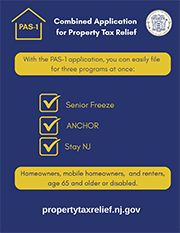
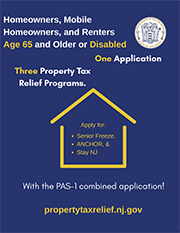
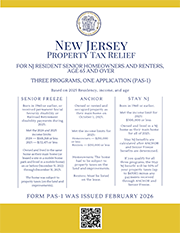
PAS-1 is the combined New Jersey application used to determine eligibility for:
- Property Tax Reimbursement, commonly called Senior Freeze.Senior Freeze eligibility
- ANCHOR.PAS-1 toolkit
- Stay NJ.Stay NJ
Senior homeowners and applicants receiving qualifying Social Security Disability or Railroad Retirement Disability benefits should review the PAS-1 filing instructions rather than assuming the standard ANC-1 application is appropriate.NJ Property Tax Relief Programs
Senior Freeze is limited to qualifying homeowners and mobile-home owners. The principal requirements generally include:
- Age 65 or older on December 31, 2025, or actual receipt of federal Social Security Disability or Railroad Retirement Disability payments by that date.Senior Freeze eligibility
- Ownership and occupancy of the same home since December 31, 2022, or earlier, subject to the program’s specific rules.Senior Freeze eligibility
- Total annual income of $168,268 or less for 2024 and $172,475 or less for 2025.Senior Freeze eligibility
- A property subject to property taxes, or qualifying mobile-home site fees.Senior Freeze eligibility
Senior Freeze generally reimburses qualifying increases in property taxes or mobile-home site fees above the applicant’s established base year.New Jersey Senior Freeze Program
Renters cannot receive Senior Freeze because the program is limited to homeowners and qualifying mobile-home owners.New Jersey property-tax-relief FAQ
Stay NJ and the renter limitation
Stay NJ is a property-tax benefit for eligible senior homeowners. For the 2025 tax-year application, the current New Jersey guidance provides:
- The applicant or spouse must have been age 65 or older during 2025.Stay NJ
- The applicant must have owned and lived in a New Jersey home for the full calendar year, January 1 through December 31, 2025.Stay NJ
- The residence may be subject to property tax or a qualifying PILOT arrangement.Stay NJ
- The current Fiscal Year 2027 budget provides 2025-tax-year Stay NJ payments for applicants with income of $200,000 or less.Stay NJ
The current maximum annualized benefit tiers are:
- Income up to $100,000: up to $6,500.
- Income from $100,000.01 through $150,000: up to $5,000.
- Income from $150,000.01 through $200,000: up to $4,000.Stay NJ
Renters and mobile-home owners cannot receive Stay NJ. A senior renter may still qualify for ANCHOR, but not for the homeowner-only Senior Freeze or Stay NJ programs.New Jersey property-tax-relief FAQ
Documents, filing, and ID.me
Prepare the following before starting:
- Social Security numbers or ITINs and birth years for the applicant and spouse, when applicable.2025 PAS-1 Instructions
- Your 2025 NJ-1040, including New Jersey gross income information.ANCHOR eligibility
- Property-tax bills, county or municipality code, block, lot, and qualifier information for homeowners.NJ Property Tax Relief Programs
- A lease, rental agreement, total rent information, and co-tenant names for renters.New Jersey property-tax-relief FAQ
- SSA-1099 or other proof of disability benefits when PAS-1 requests it.NJ Property Tax Relief Programs
- Death certificates and estate documentation for deceased applicants.2025 PAS-1 Instructions
For online filing, New Jersey uses ID.me identity verification. Have a driver’s license, state identification card, passport card, or passport available.New Jersey ID.me FAQ
If ID.me does not work:
- Start the verification through the official Property Tax Relief Portal, rather than an unsolicited text or email link.NJ Property Tax Relief Programs
- Check that your legal name and personal information match your identification documents.ID.me New Jersey guidance
- Complete the self-service camera process or select the available video-chat option.New Jersey property-tax-relief FAQ
- Use ID.me support for account-access problems; New Jersey staff cannot access or repair your ID.me account.New Jersey property-tax-relief FAQ
- File a paper application if you cannot or do not want to complete identity verification online.New Jersey property-tax-relief FAQ
Deceased applicants and payment timing
A surviving spouse or personal representative may file for an otherwise eligible deceased applicant, subject to the program’s date, residency, income, and property requirements.2025 PAS-1 Instructions
For a PAS-1 applicant who died on or after October 1, 2025, the personal representative generally must identify the estate, provide the current mailing address, include a death certificate, and sign in an official capacity.2025 PAS-1 Instructions
Current payment timing for the 2025 cycle is:
- Senior Freeze payments begin July 15 and continue according to the state payment schedule.New Jersey property-tax-relief FAQ
- ANCHOR payments begin September 15 and generally arrive within about 90 days after filing unless additional information is required.ANCHOR benefit calculation
- Stay NJ payments for the 2025 tax year are scheduled for February and May 2027 under the current budget guidance.Stay NJ
The state may limit combined property-tax benefits so they do not exceed the property taxes paid on the principal residence for the qualifying year.ANCHOR benefit calculation
PAAD and NJ SAVE are different from property-tax relief
PAAD, or Pharmaceutical Assistance to the Aged and Disabled, helps eligible New Jersey residents with prescription costs. It is not an ANCHOR, Senior Freeze, or Stay NJ payment.New Jersey PAAD
For 2026, PAAD eligibility generally requires New Jersey residency, age 65 or older or receipt of Social Security Title II Disability benefits between ages 18 and 64, and income below:
- $54,943 for a single applicant.
- $62,390 for a married applicant.New Jersey PAAD
PAAD-covered prescriptions generally have copayments of $5 for generics and $7 for brand-name drugs.New Jersey PAAD
NJ SAVE is the state’s broader application and screening system for programs that may help with prescription costs, Medicare premiums, utilities, hearing aids, and other household expenses. Programs accessed or screened through NJ SAVE include PAAD, Senior Gold, Lifeline Utility Assistance, Medicare Savings Programs, Medicare Part D Extra Help, HAAAD, USF, LIHEAP, and SNAP.NJ SAVE Programs
NJ SAVE is not a substitute for filing ANCHOR or PAS-1. A PAAD or Lifeline applicant may also be screened for property-tax-related assistance, but ANCHOR, Senior Freeze, and Stay NJ remain New Jersey Treasury programs with their own filing rules.NJ SAVE Programs NJ Property Tax Relief Programs

Common mistakes to avoid
- Using a vacation or investment property instead of the principal residence occupied on October 1, 2025.ANCHOR eligibility
- Assuming a senior homeowner can use the standard ANCHOR process instead of PAS-1.NJ Property Tax Relief Programs
- Treating a PILOT property the same for homeowners and renters, even though the rules differ.New Jersey property-tax-relief FAQ
- Reporting only a roommate’s share of rent instead of the total rent and all co-tenants.New Jersey property-tax-relief FAQ
- Ignoring a confirmation letter with an incorrect property or bank account.NJ ANCHOR filing information
- Waiting past September 15 to change banking information or reject an incorrect automatic filing.NJ ANCHOR Program
- Filing PAS-1 without reviewing income sources such as Social Security, taxable pensions, rents, business income, partnership income, or S corporation income.2025 PAS-1 Instructions
- Clicking unsolicited links that request Social Security numbers or banking information.NJ property-tax-relief scam guidance
Brick Taxes can help New Jersey residents organize eligibility information, review income and residency details, and prepare state tax-related filings. Brick Taxes is a professional tax preparation and advisory firm with federally licensed Enrolled Agent Matthew Jones, who has 25 years of tax preparation experience and an accounting background.
For assistance, visit Brick Taxes, review the available services, or call 732-540-1040. You can also review our related ANCHOR and PAS-1 overview.
This article is educational and does not determine eligibility. New Jersey’s income limits, benefit amounts, deadlines, and payment schedules may change through legislation, administrative guidance, or annual budget appropriations. Confirm the current rules with the administering agency before filing.
Official Authorities Referenced
- NJ Division of Taxation ANCHOR Program
- ANCHOR Eligibility and Filing Information
- ANCHOR Benefit Calculation
- 2025 ANC-1 Instructions
- NJ Property Tax Relief Programs
- New Jersey Property Tax Relief FAQ
- Property Tax Relief Portal
- PAS-1 Combined Application Toolkit
- 2025 PAS-1 Instructions
- Senior Freeze Eligibility Requirements
- Stay NJ Property Tax Relief
- New Jersey PAAD
- NJ SAVE Programs
- NJ Property Tax Relief and ID.me